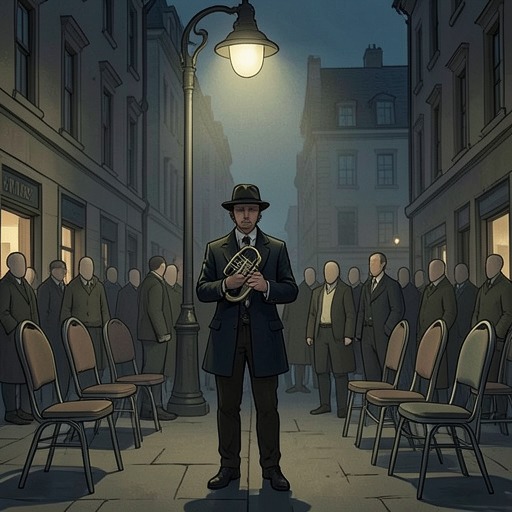
Oedipa Tracks the Muted Post Horn in San Francisco
The Crying of Lot 49Oedipa Tracks the Muted Post Horn in San Francisco follows Oedipa Maas through a night spent testing whether the Tristero clues she has gathered can be dismissed as nervous pattern-making. Instead, the muted post horn recurs in independent-looking settings, from a stranger’s lapel to a children’s game and a decades-old newspaper. The trail makes a hidden communications network seem increasingly possible while leaving its reach, history, and relation to Pierce Inverarity’s estate unresolved.
A Test of the Pattern
Oedipa arrives in San Francisco hoping that distance from the estate will help the Tristero clues dissolve. She reasons that if the organization is merely a fantasy entangled with the dead man’s property, an unplanned night in the city should yield nothing to confirm it. Her test is deliberately modest: drive around, drift through the streets, and see whether the signs stop appearing. She has already heard that Trystero opposed the Thurn and Taxis postal system in Europe and later fought the Pony Express and Wells, Fargo in America; she has also encountered claims that a California network uses W.A.S.T.E. to communicate. None of this gives her certainty, only a word and a set of associations she is trying to hold apart from coincidence.
The night quickly defeats the hoped-for negative result. Within an hour, Oedipa notices a muted post horn on the lapel pin of a man at The Greek Way, where a rowdy guided tour has brought her along with other visitors. Before approaching him, she has watched the tourists gather and follow their guide into the bar; the pin is a quiet, specific mark amid the staged spectacle. Oedipa tells its wearer that she is an agent of Thurn and Taxis, then recounts what she knows about the clues. He says he had heard of Kirby, the name on a notice she found at The Scope, but had not known about the broader history she describes. His surprise gives her account a partial corroboration without confirming the whole theory.
The Inamorati Anonymous Connection
The man explains that the pin identifies him as a member of Inamorati Anonymous, a mutual-help organization for people who regard falling in love as an addiction. Its members aim to reach a condition in which they no longer need romantic attachment. When a person seeks help, a volunteer is dispatched through an answering service; volunteers and recipients do not meet twice, a rule intended to prevent a new attachment from forming through the act of support itself. The post horn, then, appears not merely as a mark of political or postal opposition but as an emblem used by a group organized around emotional withdrawal.
He traces the group’s founding to a laid-off Yoyodyne executive who had been trained to make decisions through committees and found himself unable to decide whether to die by suicide. After a failed-subscriber correspondence arrived through a secret delivery, a newspaper report about a Buddhist monk prompted him to prepare to set himself on fire. His decision was interrupted when his estranged wife returned with the efficiency expert whose work had cost him his job. The incongruity of the interruption made him laugh; afterward, he noticed that gasoline had bleached the printing on stamps in his pocket, revealing the muted post horn as a watermark. He treated the discovery as a sign and founded a society dedicated to avoiding love, adopting the horn as its emblem. The story links the symbol to private correspondence and to an organization formed from a personal crisis, but its informality and the founder’s anonymity leave the larger network’s structure obscure.
The man suggests that Oedipa write to the founder through W.A.S.T.E., addressing the letter to “Founder, IA.” He also speculates about a whole underworld of people who survived suicide attempts and might keep in touch through the same delivery system. That remains speculation, not information he claims to possess. He leaves the bar and does not return, so Oedipa is left with an account that opens another possible branch of the network while offering no way to verify its extent.
Signs Across the City
After leaving The Greek Way, Oedipa spends the rest of the night looking for the post horn. In Chinatown she thinks she sees it among signs in a herbalist’s dark window, though the poor light makes the sight uncertain. Later she finds two horn-like images drawn in chalk on a sidewalk, with a complicated arrangement of boxes, letters, and numbers between them. She copies the diagram into her memo book, unable to tell whether it is a children’s game, a map, or a record of some secret history. A figure in a black suit watches from a doorway at a distance; Oedipa thinks she may see a turned-around collar and leaves rather than risk approaching. The sequence supplies no proof that the observer is connected to the Tristero, but it joins the recurring emblem to a growing sense of exposure.
In Golden Gate Park she encounters children in nightclothes who say they are dreaming the gathering, though the fatigue they feel in the morning makes their dream difficult to separate from waking life. They know the post horn but not the chalk diagram. For them it is an image in a jump-rope game: the players step in turn into the loop, the bell, and the mute while a girl sings. Their version turns a mark that Oedipa has treated as evidence of clandestine history into part of a communal game. The difference matters: the symbol circulates in an ordinary, shared activity, but the children offer no account of its origin or of any connection to the postal network.
Oedipa’s search also takes her to an old copy of the anarcho-syndicalist newspaper Regeneración, dated 1904. There is no stamp beside the cancellation; instead, the post horn has been hand-struck on the paper. Jesús Arrabal says such papers arrive, but cannot explain whether they have travelled through the mails for decades, reached their recipients only now, or are reprints. He does not present himself as a source with access to the network’s higher levels; he calls himself a footsoldier and says those levels have their reasons. The old newspaper expands the symbol’s apparent history while making the medium itself uncertain: the horn marks an arrival, but does not disclose when or by what route it came.
From Repetition to a Possible Network
By sunrise, the repeated emblems have changed the question Oedipa is asking. Rather than wondering only which groups might use W.A.S.T.E., she considers how many people have deliberately chosen not to communicate through the United States mail. She understands that choice as a withdrawal from the Republic’s machinery, though not necessarily as treason or public defiance. If the people she has encountered are not isolated exceptions, their refusal implies a separate, silent world of communication. That conclusion is an inference drawn from recurring signs and reported practices, not a verified count or a complete map of the network.
The public and private histories of mail delivery give her inference a political background. At The Greek Way, the stranger’s story links W.A.S.T.E. to a personal correspondence that ordinary delivery did not provide. Separately, Mike Fallopian’s research connects the Civil War era to postal reforms beginning around 1845, which he sees as a struggle in which the federal government suppressed independent routes. A historical marker at Fangoso Lagoons recalls a 1853 attack on Wells, Fargo men by masked marauders in black uniforms; its only surviving clue is a cross, which Oedipa wonders might instead be the initial T, as in The Courier’s Tragedy. These fragments offer points of comparison for the hidden network’s history, but they do not independently establish that every image or event belongs to the same organization.
Emory Bortz later describes Tristero’s American adaptation as a response to the suppression of independent carriers. In his account, its messengers crossed the country disguised as Indians and adopted silence, impersonation, and opposition masked as allegiance. That history makes the current choice of a private channel intelligible within the novel’s contest between official postal authority and alternative delivery. It also remains an account supplied by Bortz, not something Oedipa can confirm merely by seeing the horn. The trail’s force lies in the accumulation of messages, marks, and stories; its weakness is that their connections continue to depend on interpretation.
Confirmation and Doubt
The repeated post horn does not resolve whether Tristero exists as an independent organization or whether Oedipa is imagining a network by fastening together coincidences. Even evidence that seems to come from separate sources remains vulnerable to suspicion. She later recognizes that access routes to Tristero can also lead back to Inverarity’s estate: the dead man owned the shopping center containing Zapf’s Used Books and the Tank Theatre, and Emory Bortz teaches at a college he endowed. She wonders whether the people and institutions she has encountered are connected to Pierce, or whether the apparent pattern reflects her own paranoia or a deliberately staged deception. The San Francisco night therefore strengthens the pattern without making it conclusive.
Its lasting consequence is a shift in scale. Oedipa begins by hoping that one quiet night will make the mystery disappear; she ends with the possibility that numerous people have made private choices outside the official communications system. The post horn links an anonymous mutual-help group, chalk marks, a children’s game, and an old political newspaper, yet each appearance carries a different degree of certainty and a different possible meaning. The city yields not a final explanation but a denser field of clues, in which the existence of another communications world seems harder to dismiss and harder to prove.